Archive for Andy Kaiser

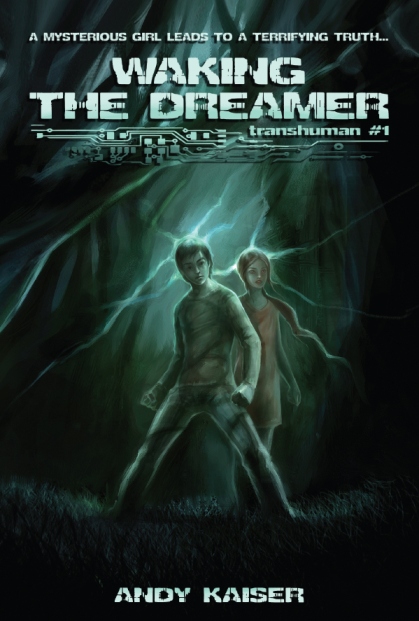
“Waking the Dreamer” cover project featured on crowdSPRING

If you’re a self-published author, you may be using Amazon’s CreateSpace to publish your book. During the book build process, you have a section for your book cover. You can choose from being able to create a book cover using built-in templates, or you can work with other advanced options. 

One option is crowdSPRING, which is what I wrote about a couple posts ago. Apparently my writeup so impressed the crowdSPRING folks that they wanted to feature me for their CreateSpace audience. So, for the time being, when a CreateSpace user clicks in the book cover section to learn more about crowdSPRING, they see me smiling back:

While I’m not sure that using my actual face is the best way to advertise anything, I hope my writeup can help others.

Thanks to Ross at crowdSPRING for helping to make this happen.

Transhuman #1: “Waking the Dreamer” is now available!

It’s done. The book was written. The costs were financed. The cover art was created. And as of today, the book was published and is available for purchase on Amazon. Get the paper book or ebook “Waking the Dreamer” now:

I do not like IBM AIX

I do not like IBM AIX
I do not like it, IBM techs!

I do not like it with a reboot
I do not like it even as root

I do not like unhelpful PS AUX
I do not like it when cd0 is lost

Instead of lurking in my subnet
I’d rather it be quarantined as a threat

I do not want it in my domain
Since the half-baked Linux eats at my brain

The perk of a system without any GUI
Is supposed to be that it won’t go kablooey

But after three IPLs, the only thing I grep
Is that I’m moving quickly from patient to upset

I do not like IBM AIX
You don’t agree? Then YOU fix this mess!

Book cover complete: My experience with crowdSPRING

Now that I have money to pay for a designer to craft a quality book cover (thanks to Kickstarter – see this post for detail), I was ready to get an artist.

Artists are expensive.

This is not a complaint – people should get paid what they’re worth. I just mean that book cover design is a specialty profession requiring not only artistic ability, but specialized technical skill in publishing and layout design, which means it costs money.

When I first started down the route to have someone else create my book cover, here are some standard prices (all are accurate, though I’ve kept the names private because I don’t know if the artists I approached want this information made public):

Artist 1: Will produce a very realistic, excellent quality, custom painting for the book cover of consisting of just about anything I want. He is the cover artist for a fairly popular children’s book series. Price: $2500.

Artist 2: An artist who is completely self-employed with their artistic skillset, and they do a lot of custom graphic design, specializing in book covers. This artist does a lot of design work for self-published authors, and the results are the kind of work you see when you walk into a book store. Price: $1500.

Artist 3: The art wasn’t this person’s day job, but the artwork was excellent. They had done a several book covers. Price: $1000.

…and I should mention that of all these artists, they had long lead times (meaning it might take weeks or months to finish) and that the quoted prices were their average, but each one could go up by another $500 to $1000, depending on the project.

All of the above is why I signed up for crowdSPRING.

What is crowdSPRING?

crowdSPRING is a collection of “creatives” – designers and artists and people who are all way better at creating book covers than me.

crowdSPRING provides the talent network, financial transactions, and the logistic and legal project management structure from start to finish. I (as the buyer) provide the project and the payment.

It’s a competition – I post a project, state what I’m willing to pay for that project, give details on what I want, then I watch the results roll in from any interested “creatives”. In my case, my project was about average for the amount of people participating: 17 artists submitted book cover concepts, and there were 65 total covers submitted (some were slightly changed versions of earlier submissions). Here is a thumbnail view of some of what I received. Click to enlarge slightly:

What does crowdSPRING cost?

It’s a bit of a sliding scale, depending on how much you’re willing to award for your project. In my case, here’s what it cost me:

Project award: $500
crowdSPRING fee: $75
Listing fee (non-refundable): $39
Advanced promotion: $99

In order to give out a $500 award, I had to pay a total of $713. In exchange, crowdSPRING gives me access to their network of creatives, the freelance artists and designers who compete to create what I want.

Was crowdSPRING worth it?

Yes, yes, very much yes. I love the service. However, I love crowdSPRING because of the creative talent it’s pulled together. Will that same level of talent be there tomorrow, or a year from now? Or when you start your own project? I certainly can’t guarantee that. However, crowdSPRING does have methods of tracking and rating various creatives, as well as providing portfolios of their past projects – ones in which they’ve won and didn’t win. You can browse this information free of charge, and I’d recommend doing so to make sure your expectations are met before you commit money.

With the above said, crowdSPRING also provides a money-back guarantee: If you’re not happy with the results, you can cancel the project, and lose nothing apart from the listing fee. So a failed project (for whatever reason) doesn’t mean you wasted a lot of project funds.

The short story: I used crowdSPRING to get a book cover designed by a great artist (many thanks to Darko Tomic!) and I’m very happy with the result.


Stay tuned for the final step in the publication process. In about a month, I’ll have a book!

Funding a book cover: My experience with Kickstarter

As it relates to my latest book, I’m trying something very new to me: Crowdsourcing and (for a lack of a better term) Crowdcreating. This post is about the former. My next post will cover the latter.

What is Kickstarter?

My situation is that I need help to cover the up-front costs of paying for an artist to design a cover for my latest book. So I signed up for Kickstarter, a crowdsourcing agency: You publicly post what you’re trying to accomplish, what rewards you’re willing to give depending on what people are willing to contribute, and other people pledge money to you. If you meet your goal, you get money. There are no “partial wins” – if you don’t get enough pledges to meet your goal, you get nothing and your contributors pay nothing, but you are free to try again.

What does Kickstarter cost?

At the time of this writing, Kickstarter takes 5% of the total contributed amount of winning campaigns, and then Amazon (the credit card and money processing agency) takes another 3%-5%. So, estimate 9% is cut off the top before you get any money. In my case above, my campaign earned $880. I’ll actually get about $800.

What did I learn about Kickstarter?

Instead of signing up for Kickstarter and having to pay their fees, couldn’t I instead just ASK people for money and give them various rewards? Sure, I could do that, but that’s a low-volume, non-automated method.

If you want to take a loan from a friend or family member, by all means, go for it. But if your intent is to raise a lot of money or reach a lot of people, you may want assistance from a proper tool like Kickstarter.

Kickstarter is powerful: Kickstarter gives a creator access to a massive number of potential pledges, arguably far beyond what they could generate on their own, allows the creator to easily track everything related to the project, allows pledges to maintain and change their accounts without bothering the creator, allows the creator to contact contributors via subset or en masse, and it has a built-in payment and accounting system. It’s cool.

The money does not magically appear: Your project may not be as profitable as what’s displayed in the Kickstarter promotional material. Yes, as you browse through the Kickstarter site, there are many cool projects out there. Many have raised amazing amounts of money. Many have succeeded.

My own project is not one of these. It would’ve failed without an unexpected boost from one of my family members. With two days remaining on my campaign, I was barely over halfway to my $700 goal.

If and when I do this again, I know what I need to do differently for next time:

Have a video introduction: Kickstarter’s instructions even tell you to do this. You should have a video because it’s more personal, helps generate more goodwill, and (hopefully) makes your project appear more professional. I did not do a video, thinking that something as straightforward and simple as a book cover didn’t warrant one. I was wrong.

Another reason to have a video: What I missed in the small print was that if you have a video, you will be included on the Kickstarter website’s promotional pages. If you don’t have a video, your project is never highlighted.

I didn’t have a video intro for my project. Next time, I definitely will.

Have a big fan base: I currently have about one thousand people in contact lists, and I run nine websites. It’s not enough. In terms of generating interest for a Kickstarter project, it’s abysmal.

My results were great, if you only counted my friends and family. As for fans or people who didn’t know me personally? I only had four (yes: one, two, three, FOUR) non-friends-or-family contributing to my campaign, and it’s those strangers that will really make the difference between success and failure. Otherwise, yes: You’re better off asking for a loan from a family member.

I need to have an exponentially larger fan base before I can expect to pull significant Kickstarter pledges.

What’s next?

I know that I’m lucky to have had my Kickstarter project complete successfully. My next attempt will see my results bolstered by new information, more fans and better technique.

Of course, that’s all for later. Now that I have the money, I’m very eager to take the next step: Let’s get an artist for this book cover!

Voice precognition: One reason more why brick-and-mortar stores are disappearing

I placed the shrink-wrapped box on the counter and the checkout girl smiled at me. She had a light in her eyes, an intimate twinkle that was hard to match, unless you were genetically gifted or practiced a lot.

It went downhill from there.

“Hi, how are you doing today?”

Her first question was fine. The second one, asked as she scanned my purchase, told me everything I needed to know about the rest of our relationship.

“Would you like to purchase our extended warranty program that gives you peace of mind against hardware problems for an additional two years?”

“No thanks, I’m not interested.”

“May I ask why?”

“It’s just a fifty-dollar device. If it breaks within a year, it’s still under factory warranty and I’ll get it exchanged. If it makes it longer, it probably won’t break between years one and three. Besides, all extended warranty policies like this are done for a profit – the customers lose in the long run. So while I do realize some situations call for an extended warranty, mine isn’t one of them. I stopped in to quick get this thing – I could’ve ordered it online for less cost, but I wanted it today, and now I just want to get back to my office.”

…I would’ve said that, but I didn’t. I just shrugged and looked away. Her eyes lost a little of their twinkle, and her lips changed from their happy-looking parabola to a resolved parallelogram. It was clearly my fault I wasn’t spending more money, and by doing so I was disappointing her personally.

She tried again.

“Are you a member of our ‘Super Savers’ program?”

“No, thank you.”

“Just so you know, I don’t work on commission! Can I interest you in our interest-free credit card that gets you 5% off every in store-purchase?”

“No, thanks.”

She hovered carefully-painted fingernails above the cash register keyboard.

“Can I get your home phone number for our records?”

“No.”

My answers were growing shorter. Just like my temper.

All I wanted to do was to spend fifty bucks and leave. If she kept asking me questions, my clearly-throbbing forehead vein was going to pop and she’d be responsible for the mess.

“Why is it so hard,” I said, frustration boiling over, “to just give you my money? I don’t want anything else!”

There. It was out. Some things just had to be said.

“I’m sorry,” she said. Her intimate eyes now flashed cold and arrogant. “I have to ask the questions. It’s just my job.”

“Just because it’s your job doesn’t make it okay.”

Again, some things just had to be said.

…Actually, everything above is what I wanted to happen. Reality was a bit different: I said “no” to all questions, paid my money, got my purchase and left, my thoughts a seething irritation. I pledged not to appear in that store again if I could help it.

Online shopping isn’t immediate, but the experience can’t be beat. A store’s customer treatment tells us exactly how they see their clients: In this case, I was a money-filled udder. Squeeze me hard and milk me dry.

Attention every store everywhere: The easier you make the shopping experience, the more likely it is that customers will come back.

Some things shouldn’t need to be said.

Transhuman #1 update: Ready for the cover art. Kickstarter is live.

The book is complete and proofed and ready to print. I even have a title:

Transhuman #1: Waking the Dreamer

What’s needed next is a cover to put around it!

Astute readers may remember a previous post, about how I’m trying a service called Kickstarter to fund the book cover costs. I’ve created my campaign and it’s officially live. Click on the picture below to check it out and see if you want to contribute:

If I’ve impressed enough people with my plea, then I’ll have a book cover! We’ll know how successful this is in one month.

How to protect your sighting of Elvis

A very brief search can easily turn up the strangest things on the Internet.

Apparently Elvis sightings are enough of an issue that the U.S. Copyright Office felt they needed to deal specifically with it, thirty-plus years after his death. The below is taken from the U.S. government’s “What Does Copyright Protect?” FAQ:

How do I protect my sighting of Elvis?
Copyright law does not protect sightings. However, copyright law will protect your photo (or other depiction) of your sighting of Elvis. File your claim to copyright online by means of the electronic Copyright Office (eCO). Pay the fee online and attach a copy of your photo. Or, go to the Copyright Office website, fill in Form CO, print it, and mail it together with your photo and fee. For more information on registration a copyright, see SL-35. No one can lawfully use your photo of your sighting, although someone else may file his own photo of his sighting. Copyright law protects the original photograph, not the subject of the photograph.

Finally, now I know what to do with all those pictures I took in Vegas.

Dev and Transhuman update

I’m very thankful for weekends. I’ve got multiple projects going right now:

Transhuman #1 is in the second round of editing. Multiple people (who are not me, or one of my alternate personalities) have the book in their hands and are hopefully, frantically, excitedly marking it up as I type this.

The Kickstarter cover art advertising project for Transhuman #1 is paused until I have the second round edits complete. I’d like to be as finished with the book text as possible before I start the cover art build campaign.

I’ve started writing another book: Dev Manny #2. Check the Dev Manny website for a sample chapter!

How to be a good writer: Writing resources from great writers

Here are the writing resources that have helped me the most. These are not only “how to write” books and expert recommendations on storytelling technique, but some detail the process of writing and storytelling, which is another thing altogether.

Beyond the obvious “write more” recommendation that everyone uses, I’m not worthy of injecting my own technique or recommendations here. All of the authors below are masters and they know what they’re talking about. All of them have, I believe, improved my own skill, so I wanted to share what’s worked for me. Use what you see below to improve your fiction writing technique and become a better writer.

“On Writing” by Stephen King

“On Writing” is part autobiography, part writer’s how-to manual. However you want to define it, it’s a fascinating story as well as great instruction. A clear and very helpful introduction to the basics of good writing. If you want to write, but don’t know anything about the passive voice, or why being concise is a good thing, or why characterization is critical, then get this book.

The Elements of Style

It’s dry and boring. It’s over fifty years old. It’s still invaluable. There’s an expression: “You must know the rules before trying to break them.” Read The Elements of Style to learn the accepted rules of writing. From commas and quotes to sentence structure, Elements teaches what’s right and wrong. Use this book so that if you write something incoherent, it’s at least intentional.

“How to Write Science Fiction & Fantasy” by Orson Scott Card and “Elements of Fiction Writing – Characters & Viewpoint” by Orson Scott Card

Now that you’ve read King’s “On Writing” and know the basics, it’s time to apply those lessons with more advanced technique. In these two books, Orson Scott Card deals with the more complex tools in the writer’s toolbox, including how to world-build and how to write proper perspective and characterization.

“Your Movie Sucks” by Roger Ebert

So you’ve read from King and Card, and have a perfect grasp on how to write and tell a good story. You’re far from getting anywhere good, because in order to know what to do, you also have to know what not to do. That’s where Roger Ebert comes in. Yes, he’s primarily a movie reviewer and here’s why it counts: There are many cliches and tropes and storytelling pitfalls, important not just in movies but in storytelling. Ebert knows them all, and you get to read about them in his collection of embarrassing examples.

Ebert has seen close to ten trillion movies, so if he doesn’t like something (and all movies in this book fall into that category), he can tell you why. More importantly, he can demonstrate why, how, where and when a movie failed. The book is extremely funny, but is (perhaps accidentally?) very educational.

“Adventures in the Screen Trade” by William Goldman and “Which Lie did I Tell?” by William Goldman

William Goldman’s screenwriting credits include Butch Cassidy and the Sundance Kid, The Stepford WivesAll the President’s Men, The Princess Bride, MiseryA Few Good Men (as a consultant), Good Will Hunting (as a consultant) and Zombieland. As for novels, he wrote many, including the classic The Princess Bride.

This is just a sampling. If you’re familiar with even one of the works named above, you know how skilled he is. William Goldman is a very, very good storyteller.

The two Goldman books linked above are a decades-spanning expose of the film industry. He’s worked with seemingly everyone, and he’s not shy about embarrassing some powerful people to make his point. When he’s not giving his thoughts on Hollywood and the movies, he talks about writing. Storytelling. Characterization. How to keep the audience involved. What mistakes he’s made, and what he’s learned over the years. These are great books for screenwriters, but there’s plenty of information to share: Authors can learn from these, too.

Now, the above are “how to write” recommendations. They are all great, but there’s more to it than having the right tools for the job. There are far more excellent authors who haven’t written any “how to” manual for aspiring writers. Find their works, read them, process them and learn.

Good luck with your own reading and writing.